The Ball-Watching Trap: Why a Player's Position Matters Without a Touch
Off-ball positioning in soccer explains how a forward can occupy a defender, open a passing lane, and help a teammate advance without touching the ball.
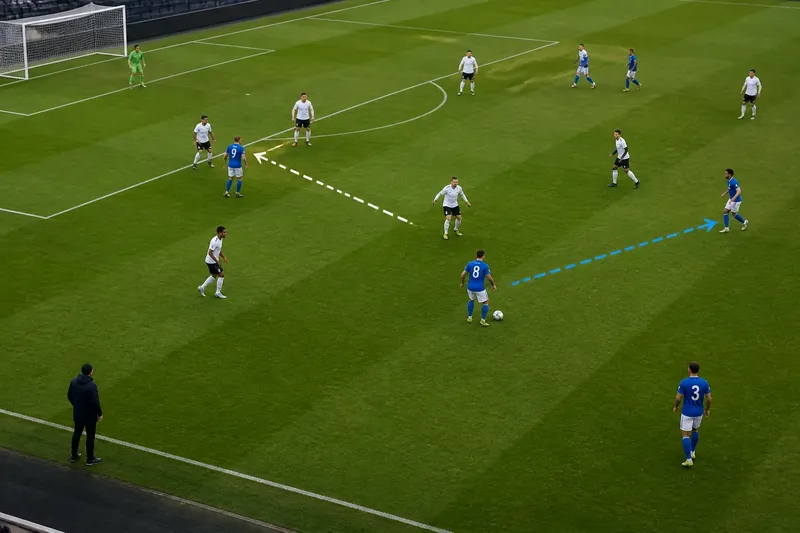
Off-ball positioning in soccer can decide whether a teammate receives the ball freely or meets a defender immediately. Watch the forward who stays near a center back while a midfielder carries the ball: the forward may not touch it, yet the defender’s attention can keep a passing lane open elsewhere.
This is the ball-watching trap: following the ball alone makes a player’s contribution seem invisible. To read the play, notice what that player’s location asks the opposition to do, and which teammate benefits as a result.
What does a player do without touching the ball?
A player without the ball can occupy a defender, offer a passing option, create room for a teammate, or help the team stay ready for a turnover. These actions happen through position and movement rather than contact with the ball.
To occupy a defender is to give that defender a reason to stay close or keep an eye on the player. A forward standing between the center backs may hold them in place. If one defender leaves to challenge a midfielder, the forward’s presence can still matter: the remaining defender may hesitate to move away from the goal.
That hesitation is not an automatic advantage. A defender might pass the forward to a teammate, step into the ball carrier’s path, or ignore the forward because another threat is more urgent. The useful question is not simply, “Is someone marked?” It is, “What choices does this position create for the defenders?”
How can a stationary player create space?
A stationary player can create space by drawing a defender toward one area or discouraging that defender from leaving it. The open space is often somewhere else, for a teammate to enter or receive the ball.
Imagine a midfielder carrying the ball through the center while a striker holds a position between two defenders. A wide teammate starts a run into the channel outside them. If a defender stays with the striker, the runner may have room. If the defender follows the runner instead, the striker may become a passing option. The striker’s position gives the defense a problem before the striker receives anything.
Space works a little like room around a chair: moving one object does not create a bigger room, but it can clear a useful path. On a field, a player’s position can pull or hold an opponent and make a route more accessible for someone else.
Look for a change in the defender, not just an empty patch of grass. Did the defender stay close to the forward? Did a teammate move into the space that defender left? Did the ball carrier now have a safer angle to pass? Those details help distinguish a meaningful decoy from a player who simply happens to be nearby.
Why does a forward sometimes run away from the ball?
A forward may run away from the ball to draw a marker out of position, clear a lane, or prepare for a later pass. The run can help even if the passer never intended to send the ball to that forward.
For instance, a forward can move diagonally toward the touchline as a teammate carries the ball centrally. A center back who follows may leave space behind for another attacker. If the defender holds the line instead, the first forward might be available for a pass wide. The same run can therefore offer two possibilities, depending on how the defense responds.
Timing matters. A run made too early may allow defenders to adjust before the ball carrier is ready. A run made too late may arrive after the passing window has closed. When reading a match, watch whether the runner begins as the ball carrier looks up or changes direction. That connection can reveal an attempt to coordinate movement, even when the pass goes elsewhere.
Not every run away from the ball is purposeful. A player may be returning to an assigned position, avoiding an offside position, or moving in response to another teammate. Treat the defender’s reaction and the team’s next action as clues, not proof of what the player intended.
How can a player open a passing lane without receiving the pass?
A player can open a passing lane by occupying a defender who would otherwise block the route to a teammate. A passing lane is the path between the ball carrier and a potential receiver that opponents cannot easily intercept.
Suppose a defensive midfielder is positioned ahead of the center backs, close enough to obstruct a direct pass into an attacking midfielder. If a forward drops toward that defensive midfielder, the marker may follow or turn to track the movement. The attacker in the middle might then have room to receive a pass from the ball carrier. Even if the ball goes to a fullback instead, the forward’s movement may have changed the defense’s shape.
To assess the lane, look from the ball carrier toward the intended teammate. Is an opponent standing in the direct route? Is another player moving that opponent away? Could the pass travel around the defender through a nearby teammate? This is why a receiver’s value is not limited to whether the ball arrives: that player can influence which routes remain available.
Passing lanes are temporary. A defender can close one with a step, and a receiver can move into an offside position while the ball is played, subject to the offside law. Positioning creates options; it does not make every pass legal, safe, or available for long.
How do defenders respond to off-ball movement?
Defenders respond by following a player, handing that player to a teammate, holding their position, or stepping toward the ball. Their choice affects which space becomes easier to use, so the response is often more revealing than the attacker’s movement alone.
When defenders follow runners closely, they can leave gaps between themselves or behind the line. When they hold a compact shape, attackers may find less room between the lines but more space in wider areas. If one defender steps out to pressure the ball, another may need to cover the space that defender leaves.
A useful way to read this is to track one defender for a few seconds. Ask whether the defender watches the ball, a nearby opponent, or both; then notice what happens when an attacker moves. This keeps attention on the interaction rather than turning the whole match into a blur of shirts.
Defensive communication and shared responsibilities can change the result. A defender who passes a runner on may prevent the gap an attacker hoped to create. The movement still matters because it required a response, but the response may have contained the threat rather than opened space.
When does off-ball positioning matter most?
Off-ball positioning matters most when a player can influence a defender at the same time as a teammate is ready to use the resulting space. A decoy without a nearby option may have little immediate effect; a teammate arriving at the right moment can turn that movement into a useful advantage.
It is especially visible when a team attacks through a narrow area. Several attackers may stand near defenders, making it difficult to move freely. One player’s run can pull a marker away, while another checks toward the ball or runs beyond the defense. Watch for the sequence: movement, defender’s reaction, teammate’s opportunity.
It also matters when a team loses possession. A player who has stayed in a position to pressure the nearest opponent may delay a counterattack, while a teammate covers a passing route. That contribution is different from creating space for an attack, but it follows the same principle: a player’s location influences the options available to both teams.
Do not judge the movement only by whether the team scores or completes a pass. The defender may respond well, the ball carrier may choose another route, or a teammate may fail to recognize the opening. Positioning can shape the decision without determining its outcome.
What should you watch when a player is away from the ball?
Watch the nearest defender and the teammate who could use the space. That pairing makes off-ball positioning easier to read than trying to follow every player at once.
- Identify the ball carrier. Note which direction the carrier faces and which passing options are visible.
- Choose an attacker without the ball. Observe whether that player holds position, checks toward the ball, or runs away from it.
- Track the closest defender. See whether the defender follows, stays, switches responsibility, or steps toward the ball.
- Look for the teammate nearby. Ask who might receive or enter the space affected by the movement.
- Check the next action. Notice whether the ball carrier passes, carries into the opening, or chooses a different option.
Say you are watching a match and a striker moves toward the left touchline while a winger cuts inside. If the center back follows the striker and the winger receives in the space between defenders, you can see how the striker’s location helped shape that opening. If the center back stays central, the striker may instead become a wide option. Either way, the defenders’ response tells you what the movement made possible.
How can you tell whether a movement is a decoy?
A decoy movement is an action that invites a defender to react so a teammate can benefit elsewhere. To judge whether a run is functioning as a decoy, look for a defender’s response and a nearby teammate positioned to exploit the space.
What is the difference between a decoy run and an ordinary run?
A decoy run draws attention or shifts a defender, while an ordinary run may simply seek the ball or move the player into a useful position. The same run can serve both purposes, and the match offers clearer evidence through the defenders’ reaction than through the runner’s appearance alone.
Does a player have to be marked to influence the defense?
No. A player can affect a defender by occupying a space the defender must protect, even if the defender is not standing close. A forward near the goal may limit how far a center back can advance, for example, because leaving the forward unattended could create danger.
Can a player help if the ball goes in another direction?
Yes. The player may have held a marker, cleared a lane, or given the ball carrier a choice that kept defenders occupied. If the defense ignores that player and the ball goes elsewhere, the position can still have influenced the shape of the play.
How do you avoid overreading a player’s intention?
Describe what you can see before guessing why it happened: the player moved toward the sideline, the defender followed, and a teammate entered the vacated area. Off-ball positioning in soccer becomes easier to understand when you separate observable movement from assumptions about intent.
Once you see the ball-watching trap, a quiet player no longer disappears from the match. Follow the defender’s attention, then look for the teammate who gains a route, a passing option, or a moment to act; that is often where the player’s contribution becomes visible.