Why Football Formations Keep Changing, From the Pyramid to the Present
Why football formations keep changing: learn how rule changes, player roles, and tactical tradeoffs reshaped the game, from the pyramid to modern systems.

Football formations keep changing because a team’s shape is an answer to the problems its players face. A pyramid loaded the attack; later systems gave more players defensive duties, then developed new ways to connect midfield and forward lines. The numbers on a team sheet capture one arrangement, not the full story of how football tactics evolved.
That history is not a march toward one perfect formation. Rules, opponents, and player skills all influence which arrangement makes sense. Like rearranging chairs around a table, moving one player changes the space and responsibilities left for everyone else.
The pyramid prioritized forward numbers
In the early years of organized football, teams commonly used a shape described as a pyramid: two defenders, three halfbacks, and five forwards. It reflected a game that placed strong emphasis on advancing and scoring. With five attackers, a team could send several players toward goal and apply pressure through numbers.
The halfbacks had a demanding position between the defenders and forwards. They helped move the ball forward, but they also had to recover and support the defense. The formation’s numbers were a rough description of where players tended to start, rather than a detailed code for every movement.
The large forward group could leave the two defenders exposed when possession changed. If an attack broke down, opponents had space to run into before the halfbacks recovered. The pyramid shows an early tradeoff: committing more players to attack left fewer positioned to protect the goal.
The offside rule prompted deeper protection
A change to the offside rule altered the risk of keeping defenders far from their own goal. As the rule allowed an attacker to be onside with fewer opposing players between them and the goal line, defenses had reason to drop deeper and maintain better cover. The old arrangement, with only two players primarily behind the midfield line, became more vulnerable to forward runs.
Teams responded by moving a player from the attacking line into a deeper role. This created another layer of protection and helped defenders deal with opponents exploiting open space. It also changed the work of the forwards: with fewer teammates close to goal, coordinated movement and passing became more valuable.
The shift illustrates how a rule changes the incentives behind a formation. When the rules make a particular space more dangerous, coaches can adjust player positions and duties to protect it.
The W-M brought attack and defense into balance
The W-M formation is commonly represented as three defenders, two halfbacks, two inside forwards, and three forwards. Its name comes from the rough letters formed by the players’ positions: a W behind and an M ahead. The extra defender added cover while the forward group retained players positioned to create and finish attacks.
The inside forwards occupied spaces between the central striker and midfield. They linked the ball forward while staying close enough to support attacks. Their role was neither simply to wait near goal nor to act as a conventional defender; they connected parts of the team that the pyramid had kept more distinct.
This arrangement offered a response to opponents who threatened through the middle. A team could protect its back line without removing every creative player from advanced positions. The W-M was not a universal solution, but it made balance a clearer design goal.
The 4-2-4 made midfield responsibilities more visible
The 4-2-4 arranged four defenders, two central midfielders, and four forwards. On paper, it looked strongly attacking, but its function depended on player decisions. Wide forwards could stretch the defense, while the central pair had to connect possession and help protect the space in front of the defenders.
If both midfielders joined an attack at once, that space could open. If they stayed too deep, the forwards might become isolated. Their choices helped determine whether the formation behaved like an attacking wave or a more cautious structure.
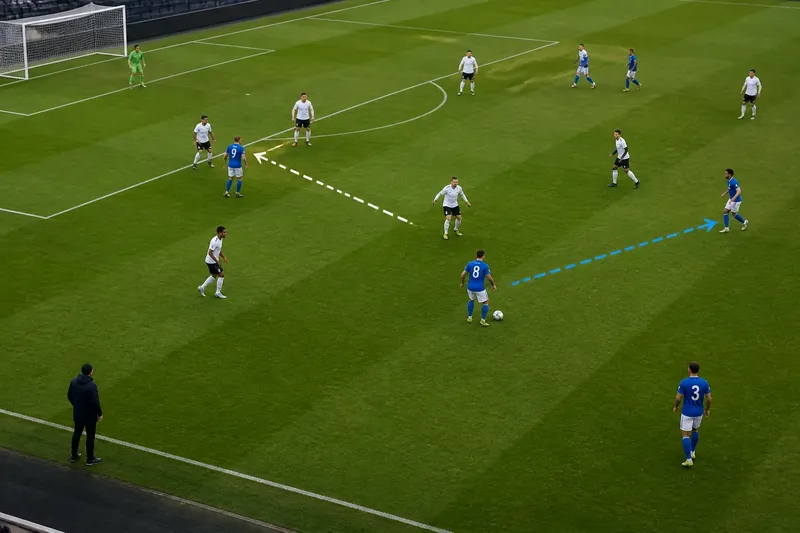
Imagine an invented team starting in a 4-2-4 against an opponent pressing high. Its right wide forward drops toward the ball, and a central midfielder moves into the space the forward has left. The team gains a nearby passing option, so the expected observable result is a more connected route out of pressure; the tradeoff is that fewer players are immediately positioned high on the right.
The 4-3-3 gave coaches more midfield options
The 4-3-3 uses four defenders, three midfielders, and three forwards. A three-player midfield can help a team retain the ball and cover passing lanes. Coaches can assign different duties: one midfielder may protect the defense, another carry the ball forward, and a third support attacks near the box.
Those duties are distinct. A holding midfielder generally stays near the defenders to screen space and offer a safe passing option. More advanced midfielders can move into gaps between the opponent’s lines, while wide forwards may cut inward or stay near the touchline to stretch the defense.
Imagine an invented team whose holding midfielder is marked tightly by an opponent. The coach asks a central defender to carry the ball forward while one advanced midfielder moves closer to offer a short pass. The expected observable result is an additional route through midfield, though the defender’s forward movement leaves a player out of the defensive line until the ball moves on or possession is lost.
What can formation history tell you about a team?
Are formation numbers fixed positions?
No. They describe a team’s broad starting arrangement, usually excluding the goalkeeper, rather than each player’s location throughout a match. A player’s movement and duties can change the shape without changing the formation label.
Why did teams add more defensive cover?
Deeper or more layered systems helped teams respond to forward runs and protect space near their goal. This did not end attacking ambition; it encouraged teams to build attacks with fewer players committed at once.
Why do midfielders feature in formation changes?
Midfielders connect defense and attack, so their positioning affects both protection and progression. Moving one higher or deeper can alter the team’s passing options and the space its opponents can use.
How can I read formation history while watching?
Watch how a team uses its midfielders and forwards in different phases, and ask what problem each role seems designed to solve. Comparing those duties with older systems makes the historical shift toward more connected responsibilities easier to see.
Formation changes reveal tradeoffs, not a final answer
The history of football formations is a record of changing priorities: forward numbers, defensive cover, and the connections between lines. Each system gave teams a different way to balance those needs, but every choice left some space or responsibility for opponents to exploit.
To make that history visible during a match, follow one midfielder rather than trying to track every player. Notice whether the player links passes, protects the defense, or supports the forwards. That single role can show why a formation changed and what its designers hoped to gain.